

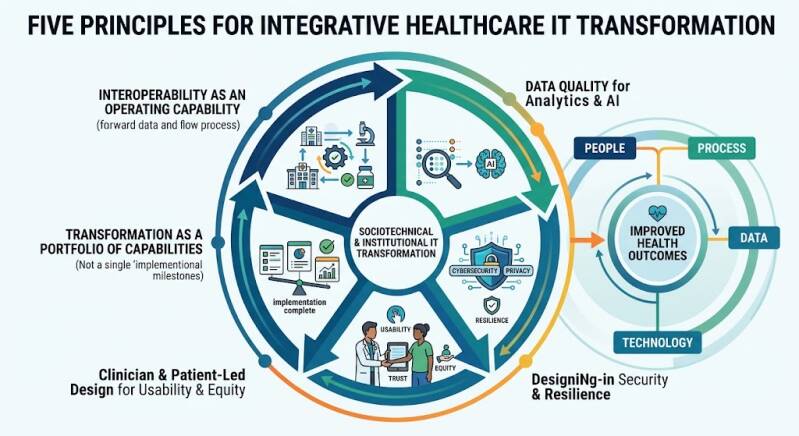
Information technology transformation in healthcare is often described as the adoption of electronic health records, cloud platforms, artificial intelligence, telehealth, and connected devices. That description is incomplete. Transformation occurs only when technology materially changes how healthcare organizations create, exchange, govern, and use information to improve clinical care and organizational performance. This integrative literature review examines healthcare IT transformation as a sociotechnical and institutional undertaking rather than a sequence of technology purchases. It synthesizes scholarship and policy concerning electronic health records, interoperability, cloud modernization, data platforms, artificial intelligence, cybersecurity, workforce redesign, patient access, and digital equity. The analysis argues that the central challenge is not digitization but coordinated redesign across clinical workflows, information architecture, governance, incentives, professional roles, and patient relationships. Five principles emerge. First, interoperability must be treated as an operating capability, not merely a technical interface. Second, data quality and semantic consistency are prerequisites for analytics and artificial intelligence. Third, cybersecurity, privacy, safety, and resilience must be designed into transformation rather than appended after deployment. Fourth, clinicians and patients must participate in design and governance because usability, trust, and equity determine whether technologies create value. Fifth, transformation should be managed as a portfolio of measurable clinical and operational capabilities rather than as a single implementation project. The paper proposes a phased transformation framework that connects strategy, governance, architecture, workflow redesign, adoption, measurement, and continuous learning. It concludes that sustainable healthcare transformation depends on the disciplined integration of people, process, data, and technology around explicit health outcomes.
DOI: https://doi.org/10.5281/zenodo.22712854
Keywords: healthcare transformation, health information technology, interoperability, electronic health records, artificial intelligence, cybersecurity, digital health, change management
Information Technology Transformation in the Healthcare Industry
Healthcare has invested heavily in digital systems, yet the presence of technology does not itself demonstrate transformation. A hospital may have an electronic health record (EHR), a patient portal, a data warehouse, and multiple artificial intelligence (AI) pilots while clinicians still reenter information, reconcile conflicting records, work around poor interfaces, and coordinate care through telephone calls, spreadsheets, and faxed documents. In such an environment, analog friction has been transferred into digital form. True IT transformation changes the organization’s capacity to deliver safe, timely, coordinated, accessible, and evidence-informed care.
Digital transformation is generally understood as an organizational response to digital technologies that changes value creation, structures, and processes (Vial, 2019). In healthcare, however, value is multidimensional. Financial performance matters, but so do patient safety, clinical outcomes, access, privacy, professional judgment, population health, and equity. A technology that accelerates billing while increasing documentation burden or fragmenting clinical attention cannot be considered an unqualified success. Healthcare transformation therefore requires a sociotechnical lens: technologies and social systems shape one another, and implementation outcomes depend on their alignment (Sittig & Singh, 2010).
The World Health Organization (WHO, 2021) similarly frames digital health as a strategic health-system capability that must integrate financial, organizational, human, and technological resources. This definition resists a common error in transformation programs: treating information technology as a department-owned initiative rather than a redesign of the care system. Health IT leaders supply essential expertise, but clinical operations, compliance, finance, quality, human resources, and patients all participate in producing the outcomes attributed to technology.
This paper is an integrative review and conceptual analysis. It draws on peer-reviewed research, government and international policy, and selected Pyrrhic Press works that bear directly on organizational resilience, interorganizational value networks, and personalized medicine. It does not report original surveys, interviews, experiments, or clinical data. Its purpose is to synthesize the major dimensions of healthcare IT transformation and propose a practical framework for health systems seeking durable rather than cosmetic change.
From Digitization to Transformation
Digitization converts information from physical to digital form. Digitalization uses digital tools to improve an existing activity. Transformation changes the underlying operating model. These distinctions matter because healthcare organizations can spend enormous sums on digitization without redesigning fragmented work. Scanned documents, electronic forms, and portal messages may reduce paper but still preserve redundant approvals, ambiguous ownership, and disconnected information flows.
The rapid diffusion of EHRs in the United States created a digital foundation for transformation, but it also exposed the gap between adoption and value. EHRs increased the availability and legibility of clinical information, supported computerized ordering, and enabled decision support. At the same time, poor usability, excessive alerts, documentation requirements, and fragmented workflows contributed to clinician frustration and burden (National Academies of Sciences, Engineering, and Medicine [NASEM], 2019). The lesson is not that EHR adoption failed. It is that a transactional system of record cannot, by itself, redesign clinical work.
Transformation begins when leaders define the capability the organization needs. Examples include closing referral loops, identifying clinical deterioration earlier, reducing medication discrepancies, enabling patients to obtain and contribute data, coordinating care across settings, or recovering safely from a cyberattack. The technology is then selected and configured around that capability. This reverses the vendor-centered sequence in which an organization buys a platform and later searches for valuable uses.
Healthcare organizations also operate within networks rather than in isolation. Patients move among primary care practices, specialists, hospitals, pharmacies, laboratories, payers, public health agencies, post-acute facilities, and community organizations. Pirro’s (2024a) Dynamic Value Networks Theory is relevant because the value of health information grows through governed relationships and timely exchange, not through isolated accumulation. A technically advanced hospital remains constrained if its partners cannot exchange or interpret data. Transformation strategy must therefore encompass the ecosystem in which care is delivered.
Interoperability as an Operating Capability
Interoperability is frequently reduced to the ability of two systems to transmit data. Transmission is necessary but insufficient. Data must be available at the right time, semantically interpretable, incorporated into workflow, reconciled with existing information, and usable for a decision. An interface that deposits an outside record into an unreviewed document queue has achieved connectivity without meaningful interoperability.
The Fast Healthcare Interoperability Resources (FHIR) standard and application programming interfaces have strengthened the technical foundation for modular exchange. SMART on FHIR demonstrated how substitutable applications can connect to EHR data through standardized services and authorization patterns (Mandel et al., 2016). In the United States, the 21st Century Cures Act and subsequent information-blocking rules further established access, exchange, and use of electronic health information as expected practice rather than discretionary behavior (Office of the National Coordinator for Health Information Technology [ONC], 2024).
Nevertheless, standards do not eliminate operational ambiguity. Organizations must determine which system is authoritative for each data domain, how identities are matched, how duplicate or conflicting values are resolved, and who is accountable for exceptions. Patient matching remains especially consequential because false merges can create safety risks while missed matches fragment longitudinal histories. Terminology also matters. Diagnoses, laboratory tests, medications, procedures, and observations require consistent coding and contextual meaning. Without semantic governance, data lakes can become collections of incompatible facts.
A mature interoperability program therefore combines architecture with stewardship. It maintains interface inventories, common data models, terminology services, master data controls, provenance, consent rules, reconciliation procedures, service-level expectations, and monitoring. It also measures whether exchange improves care. Useful measures include the percentage of referrals closed, outside records reconciled before encounters, medication histories completed, duplicate tests avoided, and transitions supported within target times. These measures convert interoperability from a technical achievement into a clinical operating capability.
Cloud, Platforms, and Data Architecture
Cloud computing can provide scalable infrastructure, managed services, disaster-recovery options, and faster access to advanced analytics. Yet cloud migration is not automatically modernization. Moving poorly governed applications into hosted infrastructure can reproduce cost, integration, and security problems at a new address. Transformation requires deliberate decisions about application rationalization, architecture, data ownership, integration patterns, and the division of responsibility between the organization and its vendors.
Healthcare data architecture must support both transactional reliability and analytical flexibility. Clinical systems of record prioritize accuracy, availability, traceability, and workflow performance. Analytical platforms combine information across domains for quality improvement, forecasting, research, and population health. Attempting to make one environment serve every purpose can produce brittle interfaces and inconsistent definitions. A better approach establishes governed pipelines from operational systems into curated analytical products, with clear lineage from source to use.
Data governance is often described abstractly, but it becomes real through decisions. Who defines an encounter? Which timestamp represents discharge? How are race, ethnicity, language, sex, gender identity, and social needs represented? When may data be reused for model development? How are corrections propagated? Who can authorize access? A transformation program that avoids these questions will eventually encode conflicting answers in dashboards, algorithms, and reports.
Platform strategy should also reduce unnecessary dependence on proprietary workflows. Standard interfaces, portable data, modular applications, and contract terms that protect access can preserve organizational options. This does not require rejecting integrated platforms; integration may reduce fragmentation and simplify support. It does require understanding the cost of switching, the limits of export, and the effect of vendor roadmaps on clinical autonomy.
Artificial Intelligence and Automation
AI has become one of the most visible elements of healthcare transformation. Potential uses include image interpretation, risk prediction, clinical documentation, patient communication, capacity planning, fraud detection, prior authorization, research, and personalized treatment. Topol (2019) argues that high-performance medicine can emerge from the complementarity of human and artificial intelligence. The critical word is complementarity. Safe transformation should augment professional judgment and reduce avoidable cognitive or administrative work, not obscure accountability behind automated outputs.
AI systems inherit limitations from their data, labels, objectives, and deployment contexts. Obermeyer et al. (2019) showed that a widely used population-health algorithm exhibited racial bias because healthcare spending was used as a proxy for health need; unequal access and spending patterns distorted the prediction. This example illustrates why technical accuracy alone is inadequate. Organizations must examine what a model predicts, which outcome is optimized, who is underrepresented, and how performance varies across populations.
Generative AI introduces additional concerns. It can summarize, draft, translate, and support information retrieval, but it can also produce plausible errors, omit context, or reveal protected information if used without safeguards. Pirro (n.d.) identifies generative AI’s potential in personalized medicine, particularly its ability to synthesize complex information and support individualized decisions. That potential is credible only when outputs are grounded in validated data, reviewed by qualified professionals, and governed according to clinical risk.
An enterprise AI governance process should cover the entire lifecycle. Before acquisition or development, the organization should define the intended use, affected population, decision owner, alternative workflow, and acceptable risk. Validation should include discrimination, calibration, subgroup performance, usability, workflow effects, and failure modes. Deployment should specify when humans may override the system, how overrides are recorded, how patients are informed where appropriate, and how incidents are escalated. Monitoring should detect performance drift, changing populations, data pipeline failures, and unintended behavior. Retirement criteria are as important as launch criteria.
Automation also deserves scrutiny even when it is not labeled AI. Robotic process automation and rule-based tools can reduce repetitive work, but automating a defective process can accelerate defects. Leaders should first remove unnecessary steps, clarify ownership, and standardize the process. Automation should follow simplification rather than substitute for it.
Cybersecurity, Privacy, Safety, and Resilience
Healthcare transformation expands the digital attack surface. Connected devices, remote access, cloud services, third-party platforms, patient applications, and data exchange create value while increasing dependencies. Cybersecurity is therefore not merely an IT control function; it is a patient-safety and continuity-of-care capability. A ransomware event can interrupt medication administration, diagnostic access, scheduling, communication, and emergency operations.
Systematic research identifies phishing, ransomware, outdated systems, human factors, and insufficient controls as persistent healthcare risks (Kruse et al., 2017). The implication is that security cannot be concentrated at the network perimeter. Modern programs require identity-centered controls, least privilege, multifactor authentication, segmentation, secure configuration, endpoint monitoring, tested backups, vendor-risk management, vulnerability remediation, and rehearsed incident response. Legacy clinical devices and systems require particular attention because they may be difficult to patch or replace.
Privacy and cybersecurity overlap but are not identical. A secure system can still use data in ways patients consider inappropriate, while a privacy rule alone does not protect system availability. Transformation governance should address confidentiality, integrity, availability, lawful use, transparency, and patient expectations. Data minimization is especially important: organizations should not collect or retain information simply because storage is inexpensive.
Resilience extends beyond prevention. Pirro’s (2024b) Universal Resilience Theory emphasizes adaptability, redundancy, and the capacity to reorganize under stress. Applied to healthcare IT, resilience includes offline clinical procedures, redundant communications, prioritized restoration, accessible downtime records, alternate sites, and staff who have practiced degraded operations. Recovery objectives must be based on clinical harm, not solely technical convenience. A laboratory interface, medication administration system, and public website do not carry identical consequences when unavailable.
Workforce, Workflow, and Change Management
Health IT implementations often fail to deliver value because they are treated as installation projects. Cresswell and Sheikh (2013) found that organizational issues, professional roles, workflow, leadership, and context are central to health IT implementation. Greenhalgh et al. (2017) likewise demonstrate through the Nonadoption, Abandonment, Scale-up, Spread, and Sustainability framework that technology adoption is shaped by the condition, technology, value proposition, adopters, organization, wider system, and change over time.
These findings have practical consequences. Clinical participation cannot be limited to final-stage user acceptance testing. Clinicians, operational staff, informaticists, patients, security specialists, and accessibility experts should participate in problem definition, workflow mapping, design, configuration, testing, training, and measurement. Participation does not mean every preference is implemented. It means decisions are informed by the realities of work and their tradeoffs are visible.
Workflow redesign should distinguish necessary clinical work from administrative residue. Documentation should support care, communication, legal requirements, and justified secondary uses; it should not expand without limit because each department can add another field. Alert governance should examine clinical importance, specificity, actionability, and cumulative burden. Patient-message workflows should include routing, response expectations, escalation, coverage, and workload capacity rather than simply opening another digital channel.
Training must also move beyond feature demonstration. Role-based simulation, realistic scenarios, protected practice time, and support during early use are more effective than generic exposure. Local champions can translate between technology and practice, but they should not be used as unpaid substitutes for formal support. Leaders must monitor workload, burnout, errors, and workarounds after launch because adoption metrics can conceal unsafe adaptation.
Change management is ultimately about legitimacy. People are more likely to engage when they understand the problem, see evidence behind the intervention, influence design, receive adequate support, and believe leaders will respond to negative consequences. Trust erodes when transformation is marketed as clinical improvement while experienced primarily as surveillance, cost reduction, or additional work.
Patient Access and Digital Equity
Patient portals, telehealth, remote monitoring, mobile applications, and digital navigation can expand access and strengthen participation. They can also reproduce or deepen disparities. Access depends on broadband, devices, affordability, language, disability accommodations, digital literacy, privacy at home, and confidence in institutions. A nominally available digital service is not equitable if substantial groups cannot use it effectively.
The concept of digital determinants of health recognizes that access to technology and the skills required to use it increasingly shape healthcare access (WHO, 2021). Transformation programs should therefore measure use and outcomes across demographic and geographic groups, not only total enrollment. Portal activation, video-visit completion, response time, device connectivity, and remote-monitoring adherence should be stratified where lawful and appropriate. Differences should trigger investigation rather than assumptions about patient motivation.
Equitable design provides multiple channels. A digital-first strategy may be efficient, but digital-only care can exclude people. Telephone, in-person, caregiver-supported, accessible, and translated options remain necessary. Patients should also be able to understand how their information is used and how automated systems affect their care. Transparency must be practical rather than buried in legal language.
A Phased Framework for Healthcare IT Transformation
A durable transformation program can be organized into seven connected phases. The phases are iterative; organizations may revisit earlier decisions as evidence changes.
- Define Outcomes and Boundaries
Leaders should begin with measurable clinical, patient, workforce, operational, and financial outcomes. The scope must identify affected populations, care settings, dependencies, regulatory constraints, and explicit exclusions. A target such as “improve interoperability” is too vague. “Increase the percentage of specialist referrals with returned consult information within 14 days” creates a capability that can be designed and measured.
- Establish Governance and Decision Rights
Governance should specify who owns outcomes, data domains, clinical standards, architecture, privacy, cybersecurity, AI approval, funding, and benefit realization. Decision rights need escalation paths for unresolved conflicts. Patient and frontline representation should be built into governance rather than requested only after resistance appears.
- Assess the Current State
The organization should inventory applications, interfaces, data flows, vendors, contracts, manual work, technical debt, downtime risks, skills, and active projects. Workflow observation is essential because formal process maps often omit workarounds. The assessment should identify where information is reentered, delayed, lost, contradicted, or inaccessible.
- Design the Target Capability and Architecture
Target design connects clinical workflows with information, applications, integration, identity, infrastructure, and controls. It defines authoritative sources, common terminology, exchange standards, retention, access, and fallback procedures. Architecture should remain proportional: not every improvement requires a new enterprise platform.
- Implement Incrementally With Safety Controls
Pilots should be selected for learning value, not merely visibility. Implementation plans should include usability testing, privacy and security assessment, clinical safety review, data validation, training, support, downtime planning, and rollback criteria. Incremental delivery allows the organization to correct assumptions before scaling.
- Measure Outcomes and Unintended Effects
Measurement should combine adoption, process, outcome, balancing, and equity indicators. Faster documentation may coincide with reduced note quality; increased portal use may increase clinician inbox work; predictive alerts may improve sensitivity while producing fatigue. Balancing measures reveal whether value in one area creates harm elsewhere.
- Scale, Sustain, and Retire
Successful pilots require resources for support, monitoring, upgrades, training, and governance. Scaling should consider variation among sites and populations rather than assuming identical conditions. Legacy systems, duplicative reports, interfaces, and manual processes should be retired when safe; otherwise, the organization accumulates complexity instead of transforming it.
Discussion
The literature indicates that healthcare IT transformation is best understood as capability building under conditions of high consequence and institutional complexity. The central unit of change is not the application but the care process and information ecosystem. EHRs, cloud platforms, AI, and telehealth can support transformation, but their effects depend on governance, workflow, data quality, incentives, and trust.
Three tensions require continuing leadership attention. The first is standardization versus local adaptation. Standardization supports safety, exchange, and scale, but excessive uniformity can ignore clinical variation. The second is speed versus assurance. Urgency may be justified, particularly during crises, but rapid deployment without validation transfers risk to patients and staff. The third is data use versus patient autonomy. Broader data access can improve coordination and discovery, yet legitimacy depends on privacy, transparency, security, and responsible use.
The proposed framework also reframes return on investment. Financial benefits remain important, but healthcare transformation should account for safety, access, workforce experience, resilience, and avoided harm. Some capabilities, such as downtime preparedness or semantic governance, may appear as costs until a crisis or analytic failure reveals their value. Portfolio governance can balance near-term efficiencies with foundational investments.
Limitations and Future Research
This paper is an integrative review rather than a systematic review or meta-analysis. It does not claim exhaustive database coverage, formal study-quality scoring, or quantitative effect estimates. The healthcare industry also varies substantially across countries, payment models, organizational sizes, and care settings; recommendations may require adaptation. Rapid changes in AI, cybersecurity, regulation, and interoperability may outpace parts of the literature.
Future research should compare transformation portfolios across health systems using common measures of clinical outcomes, workforce burden, equity, resilience, and total cost. Longitudinal studies are needed to distinguish temporary implementation disruption from sustained effects. Research should also examine how patients and clinicians perceive AI governance, how digital access strategies affect marginalized populations, and which organizational structures best support safe retirement of legacy systems.
Conclusion
Healthcare IT transformation is not achieved when an organization purchases modern technology or completes a go-live. It is achieved when the organization can use trustworthy information and well-designed digital capabilities to deliver better care, coordinate across boundaries, protect patients, support its workforce, and learn continuously. Interoperability, data governance, cybersecurity, resilience, AI oversight, workflow redesign, and equity are not parallel side projects. They are interdependent features of the same transformation system.
The most durable strategy begins with outcomes, assigns decision rights, understands current work, designs coherent capabilities, implements incrementally, measures unintended effects, and retires obsolete processes. This approach is less dramatic than technology-centered transformation rhetoric, but it is more likely to create lasting value. In healthcare, the standard for transformation must remain demanding: technology should make care safer, more intelligible, more accessible, and more humane.
References
Cresswell, K. M., & Sheikh, A. (2013). Organizational issues in the implementation and adoption of health information technology innovations: An interpretative review. International Journal of Medical Informatics, 82(5), e73-e86. https://doi.org/10.1016/j.ijmedinf.2012.10.007
Greenhalgh, T., Wherton, J., Papoutsi, C., Lynch, J., Hughes, G., A'Court, C., Hinder, S., Fahy, N., Procter, R., & Shaw, S. (2017). Beyond adoption: A new framework for theorizing and evaluating nonadoption, abandonment, and challenges to the scale-up, spread, and sustainability of health and care technologies. Journal of Medical Internet Research, 19(11), e367. https://doi.org/10.2196/jmir.8775
Kruse, C. S., Frederick, B., Jacobson, T., & Monticone, D. K. (2017). Cybersecurity in healthcare: A systematic review of modern threats and trends. Technology and Health Care, 25(1), 1-10. https://doi.org/10.3233/THC-161263
Mandel, J. C., Kreda, D. A., Mandl, K. D., Kohane, I. S., & Ramoni, R. B. (2016). SMART on FHIR: A standards-based, interoperable apps platform for electronic health records. Journal of the American Medical Informatics Association, 23(5), 899-908. https://doi.org/10.1093/jamia/ocv189
National Academies of Sciences, Engineering, and Medicine. (2019). Taking action against clinician burnout: A systems approach to professional well-being. National Academies Press. https://doi.org/10.17226/25521
Obermeyer, Z., Powers, B., Vogeli, C., & Mullainathan, S. (2019). Dissecting racial bias in an algorithm used to manage the health of populations. Science, 366(6464), 447-453. https://doi.org/10.1126/science.aax2342
Office of the National Coordinator for Health Information Technology. (2024). Information blocking. https://www.healthit.gov/topic/information-blocking
Pirro, N. J. (n.d.). The unexplored potential of generative AI in personalized medicine. Pyrrhic Press Publishing. https://www.pyrrhicpress.org/foundational-works-collection
Pirro, N. J. (2024a). Dynamic Value Networks Theory (DVN): Harnessing interconnected relationships for value creation. Pyrrhic Press Publishing. https://doi.org/10.5281/zenodo.11120455
Pirro, N. J. (2024b). Universal Resilience Theory. Pyrrhic Press Publishing. https://doi.org/10.5281/zenodo.10997597
Sittig, D. F., & Singh, H. (2010). A new sociotechnical model for studying health information technology in complex adaptive healthcare systems. Quality & Safety in Health Care, 19(Suppl. 3), i68-i74. https://doi.org/10.1136/qshc.2010.042085
Topol, E. J. (2019). High-performance medicine: The convergence of human and artificial intelligence. Nature Medicine, 25, 44-56. https://doi.org/10.1038/s41591-018-0300-7
Vial, G. (2019). Understanding digital transformation: A review and a research agenda. The Journal of Strategic Information Systems, 28(2), 118-144. https://doi.org/10.1016/j.jsis.2019.01.003
World Health Organization. (2021). Global strategy on digital health 2020-2025. https://www.who.int/publications/i/item/9789240020924