

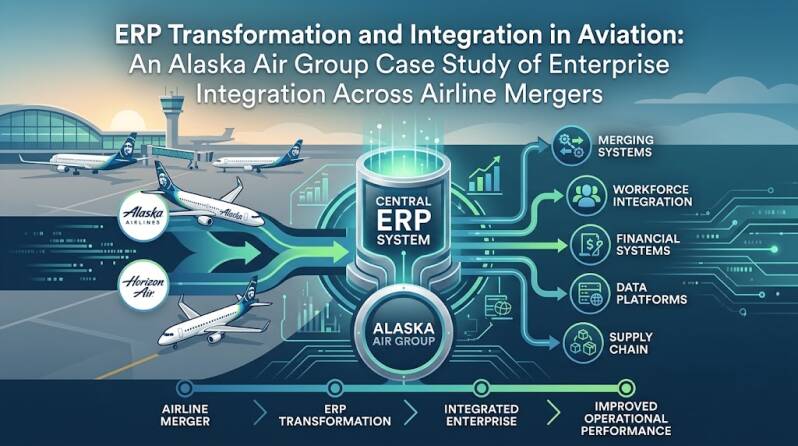
Enterprise resource planning transformation in aviation extends far beyond the replacement of accounting software. Airlines operate as tightly coupled networks in which finance, workforce management, procurement, maintenance, inventory, airport operations, reservations, loyalty, revenue management, safety, and regulatory reporting must exchange reliable information in near real time. This paper examines enterprise transformation and integration through a public-record case study of Alaska Air Group. The case draws on Alaska’s acquisition and integration of Virgin America and its later combination with Hawaiian Airlines. Public disclosures show recurring integration milestones: consolidated back-office functions, common payroll and benefits, a single operating certificate, unified loyalty capabilities, and migration to a common passenger service system. These events provide a useful basis for examining how an airline can coordinate enterprise resource planning with operational platforms without falsely treating the ERP as the sole system controlling the airline. The analysis distinguishes documented company actions from the author’s proposed target architecture and governance model. It argues that successful aviation integration requires a governed enterprise data model, explicit system-of-record decisions, sequenced operational cutovers, regulatory traceability, workforce participation, cybersecurity controls, and benefit measurement. A seven-domain transformation framework is proposed for finance, people, procurement, asset and maintenance information, commercial operations, enterprise data, and risk. The case demonstrates that ERP value emerges through integration with passenger service, maintenance, crew, airport, loyalty, and analytics systems. The paper concludes that airline ERP transformation should be governed as an enterprise capability portfolio whose first priorities are safety and operational continuity, followed by customer integrity, control effectiveness, workforce adoption, and financial synergy.
Keywords: enterprise resource planning, ERP transformation, systems integration, aviation, Alaska Airlines, Alaska Air Group, Hawaiian Airlines, airline mergers
Introduction
Enterprise resource planning (ERP) is commonly associated with general ledger, accounts payable, purchasing, human resources, payroll, budgeting, and asset accounting. In aviation, however, these functions exist inside a far more complicated operational ecosystem. An airline must coordinate aircraft, crews, airports, maintenance requirements, reservations, baggage, loyalty programs, revenue controls, vendors, regulators, and irregular operations. Many decisions occur under severe time constraints, and apparently small data defects can propagate across the network. An employee record affects scheduling and access; a part record affects maintenance and aircraft availability; a vendor or contract record affects procurement, payment, and service continuity; and a flight or customer record affects revenue recognition, loyalty, communication, and recovery.
Consequently, ERP transformation in aviation cannot be evaluated as a self-contained software implementation. The ERP is one component of an enterprise platform landscape. Passenger service systems (PSSs), maintenance and engineering systems, crew-management tools, flight operations platforms, departure-control systems, customer applications, loyalty systems, data platforms, and safety systems may remain specialized. The transformational challenge is to establish coherent ownership and exchange across those systems while retiring redundant processes and preserving uninterrupted operations.
Alaska Air Group provides a valuable case because it has completed one major airline integration and undertaken another within a decade. Air Group acquired Virgin America in 2016 and completed major operational and technology integration milestones in 2018. It acquired Hawaiian Holdings in September 2024, unified important customer and operating capabilities during 2025, and transitioned Hawaiian Airlines to the Sabre PSS used by Alaska Airlines in April 2026 (Alaska Airlines, 2018a, 2026a; Alaska Air Group, 2026). These integrations should not be described as public proof of any particular ERP product or proprietary architecture. Alaska’s public disclosures do not reveal every internal application, interface, data model, or control. They do, however, document enough milestones to analyze the structure, sequencing, and governance of enterprise integration.
This paper uses an explanatory case-study method based on public company releases, regulatory filings, and established research on enterprise systems, transformation, and integration. It does not use confidential Alaska Air Group information, employee interviews, or original operational data. Documented facts are distinguished from analytical recommendations. The research question is: What does Alaska Air Group’s merger-integration experience reveal about the design and governance of ERP-centered transformation in a safety-critical airline environment?
ERP Transformation in the Airline Context
ERP systems create value by replacing fragmented records and inconsistent processes with shared transactional structures. Davenport (1998) warned, however, that enterprise systems impose their own logic on strategy, culture, and organization. The central decision is not merely whether software can perform a transaction. It is whether the organization will standardize its work around the system, configure the system around local work, or preserve multiple patterns through exceptions and interfaces.
Airlines intensify this tension. Standardization supports common controls, efficient training, comparable reporting, and scalable operations. Local adaptation may still be necessary because aircraft types, labor agreements, station conditions, international requirements, brand promises, and regulatory approvals vary. An acquisition can therefore create misalignment among data, process, policy, contract, technology, and culture. Soh et al. (2000) describe these as organizational and cultural misfits between enterprise-system assumptions and institutional practices.
The phrase “ERP transformation” must also be used carefully. A PSS manages reservations, ticketing, inventory, and aspects of passenger processing. A maintenance platform manages airworthiness-related configuration and work. A crew system supports qualification and assignment. None should be casually absorbed into the ERP label. The ERP becomes transformational when it provides governed enterprise capabilities and reliable integration across specialized systems. For example, maintenance demand can create procurement and inventory transactions; labor systems can feed financial allocation and access controls; passenger and loyalty activity can feed revenue and liability accounting; and vendor performance can influence operational planning.
ERP success is therefore dependent on a wider integration model. Research consistently identifies executive sponsorship, project management, business-process redesign, data quality, user participation, change management, training, and clear objectives as critical factors (Al-Mashari et al., 2003; Loonam et al., 2018; Somers & Nelson, 2004). These factors become more consequential during a merger because the transformation program must integrate two operating histories while the combined enterprise continues serving passengers.
Case Background: Alaska Air Group
Virgin America Integration
Alaska Air Group completed its acquisition of Virgin America in December 2016. The integration required more than legal consolidation or brand change. Alaska’s reporting identified the challenge of integrating operating procedures, regulatory programs, technology, fleets, networks, workforces, and customer relationships while minimizing disruption (Alaska Air Group, 2016).
By early 2018, Alaska and Virgin America had obtained a single operating certificate from the Federal Aviation Administration (FAA). Alaska reported that more than 110 employees contributed approximately 70,000 hours, reviewed 346 operational topics across 136 manuals, analyzed more than 39,000 pages, made roughly 1,500 policy and procedure changes, and trained more than 10,500 frontline employees (Alaska Airlines, 2018a). The specificity of these activities illustrates a central lesson: enterprise integration is a controlled reconciliation of operating definitions, authorities, procedures, and competencies. Software cutover without that reconciliation would have created a digital veneer over unresolved operating differences.
The company also moved to one payroll and benefits program, integrated loyalty activity, and transitioned toward a single PSS. In April 2018, Alaska reported that the combined airline had moved to one reservation system, website, mobile application, airport brand, and call-center environment (Alaska Airlines, 2018b). Company accounts later described the technology effort as involving dozens and, across the broader portfolio, hundreds of systems (Alaska Airlines, 2019, 2020).
This history is relevant to ERP transformation because it demonstrates sequencing. Employee, policy, regulatory, loyalty, reservation, channel, and operational changes were related but not collapsed into one event. The single operating certificate provided regulatory and procedural unity. The PSS cutover provided commercial and passenger-processing unity. Back-office integration created common workforce and financial administration. Each milestone reduced a distinct class of fragmentation.
Hawaiian Airlines Combination
Air Group completed its acquisition of Hawaiian Holdings on September 18, 2024. Its initial integration roadmap identified three major near-term milestones: a single loyalty platform, a single operating certificate, and PSS integration (Alaska Air Group, 2024). Air Group’s 2025 Form 10-K stated that the company consolidated most back-office functions, established station co-locations, and began integrating operational systems. It launched Atmos Rewards as a combined loyalty program in August 2025 and received a single operating certificate in October 2025, while preserving Hawaiian as a distinct customer-facing brand (Alaska Air Group, 2026).
The PSS integration was deliberately staged. Public investor material indicated that the selling cutover occurred in October 2025 for Hawaiian-branded flights departing after the planned operational transition. On April 22, 2026, Hawaiian transitioned to the Sabre PSS used by Alaska, allowing the brands to share reservation infrastructure and a combined application experience (Alaska Airlines, 2026a). This separation between advance selling and operational cutover illustrates controlled migration: future transactions can be directed into the target environment before day-of-travel operations fully transition.
The Hawaiian integration also differs strategically from the Virgin America integration. Virgin America’s consumer brand was retired, whereas Alaska intends to preserve both Alaska and Hawaiian brands. Enterprise standardization must therefore coexist with customer-facing differentiation. A unified ERP and common back-office controls need not erase brand identity. The architectural goal should be shared enterprise truth with configurable brand presentation.
What the Public Case Establishes—and What It Does Not
The public record supports several factual conclusions. Alaska has used milestone-based integration governance. It has consolidated significant back-office activity. It has pursued single operating certificates and common PSS environments. It has combined loyalty capabilities and coordinated brand, workforce, airport, and operational change. Its earlier integration created institutional experience that management explicitly described as a playbook for the Hawaiian combination (Alaska Air Group, 2024).
The record does not establish the brand or version of Alaska’s core financial ERP, the detailed boundaries of its human-capital, procurement, asset, or analytics platforms, or the complete interface architecture. It would be inappropriate to invent those details. The remainder of this paper therefore presents a proposed ERP-centered integration framework derived from the case and literature, not a claim that Alaska has implemented every component exactly as described.
A Proposed ERP-Centered Integration Architecture
Finance and Enterprise Performance
The financial domain should provide a consistent chart of accounts, legal-entity structure, cost centers, projects, routes or operational dimensions, capital accounting, intercompany rules, revenue interfaces, tax treatment, consolidation, and management reporting. During acquisition integration, mapping every legacy account directly into the target structure can preserve needless complexity. The organization should instead define reporting and control requirements first, then construct crosswalks and retirement rules.
Airlines require precise connections between operational events and financial outcomes. Ticket activity, loyalty obligations, airport charges, fuel, maintenance, crew costs, disruption expenses, and vendor services originate outside the general ledger. The finance design must preserve transaction provenance and reconciliation. Summary interfaces may improve performance, but sufficient detail must remain available to explain balances and resolve exceptions.
People, Payroll, and Organizational Identity
The employee master connects human resources, payroll, scheduling eligibility, training, security access, expense, procurement authority, and organizational reporting. Alaska’s movement to common payroll and benefits during the Virgin America integration demonstrates that workforce administration is an early enterprise integration concern (Alaska Airlines, 2018a).
A target model must accommodate union representation, collective bargaining agreements, seniority, qualifications, bases, job classifications, and brand or operating assignments. These are not merely HR attributes. They influence scheduling, access, cost allocation, and regulatory compliance. Identity integration should follow authoritative employment and qualification records, with automated deprovisioning and segregation-of-duties monitoring.
Procurement, Vendors, and Supply Continuity
Airlines depend on fuel suppliers, airports, maintenance providers, caterers, technology vendors, ground handlers, parts suppliers, and professional services. Mergers typically reveal duplicate vendors, conflicting payment terms, multiple identifiers, and overlapping contracts. A governed vendor master should distinguish the legal supplier, operating location, remit-to entity, contract, risk status, and service relationship.
Consolidation can create purchasing leverage, but aggressive standardization can also create concentration risk. Pirro’s (2024a) Universal Resilience Theory and the Synergistic Organizational Resilience and Evolution framework emphasize adaptive redundancy rather than efficiency without buffers (Pirro, 2025). In aviation, procurement transformation should evaluate whether supplier consolidation reduces cost at the expense of recovery capacity. Critical goods and services may justify alternate sources and contingency contracts.
Asset, Inventory, and Maintenance Information
The ERP may account for aircraft, engines, facilities, rotable parts, consumables, and capital projects, but specialized maintenance systems should retain airworthiness configuration and maintenance execution where appropriate. Integration must prevent disagreement among the financial asset register, maintenance configuration, inventory balance, and physical reality.
Master-data governance should define identifiers, serial numbers, ownership, lease status, location, condition, valuation, and lifecycle state. Transfers between brands, stations, or maintenance organizations require controlled events rather than spreadsheet adjustments. Reconciliation must be continuous because a technically balanced ledger does not prove that a part is physically available or eligible for installation.
Commercial, Passenger, and Loyalty Integration
The PSS is not the ERP, but it is a major source of financial and customer transactions. Alaska’s PSS cutovers demonstrate the importance of establishing one commercial transaction environment. The PSS, loyalty platform, payment environment, revenue accounting, customer service, and finance systems must agree on ticket status, ancillary services, refunds, exchanges, flown activity, and loyalty earning or redemption.
Atmos Rewards also creates a shared enterprise relationship across distinct brands. The customer model must recognize an individual consistently while respecting consent, privacy, brand preferences, and partner relationships. Pirro’s (2024b) Dynamic Value Networks Theory is applicable because airline value is created through interactions among passengers, partner airlines, issuers, airports, suppliers, and service organizations. Integration should enable these relationships without allowing uncontrolled copies of customer or transaction data.
Enterprise Data and Integration Services
An airline integration layer should decouple core applications where practical. Application programming interfaces, event streams, managed file exchanges, and integration services can connect systems, but technology patterns alone do not create coherence. Each data object requires an owner, authoritative source, quality rules, lineage, and exception process.
The most important enterprise objects include employee, customer, vendor, airport, station, aircraft, flight, route, part, contract, account, organizational unit, and loyalty member. A canonical model does not require every system to store identical structures. It requires controlled translation and stable meaning. Integration monitoring should identify latency, failures, duplicates, rejected transactions, and reconciliation differences before they become operational disruptions.
Cybersecurity, Controls, and Operational Resilience
Mergers increase cybersecurity risk because networks, identities, vendors, and data are joined while teams are simultaneously changing processes. Access inherited from legacy systems can create excessive privilege. Interfaces built under schedule pressure can bypass standard controls. Transformation governance should include identity convergence, privileged-access review, vulnerability assessment, logging, segmentation, vendor assurance, and tested recovery.
Operational continuity must govern cutover decisions. The goal is not merely to avoid a technical rollback. It is to preserve the airline’s ability to dispatch flights, process passengers, manage crews, communicate, and account for transactions safely. Alaska’s recent history also illustrates the materiality of technology availability: public reporting described system outages that resulted in ground stops and network disruption. Such events reinforce the need for redundancy, degraded-mode procedures, and decision rights that prioritize safety over schedule recovery.
Transformation Governance and Sequencing
Establish Integration Principles
Leaders should agree on principles before resolving individual application disputes. Examples include: safety before synergy; one authoritative source for each enterprise object; standardized controls with justified local variation; customer continuity during cutover; no migration without reconciliation; no interface without an owner; and no legacy retirement without evidence that records, controls, and recovery needs have been addressed.
Organize Around Capabilities, Not Applications
Programs often divide work into “ERP,” “data,” “operations,” and “commercial” teams. This structure is administratively convenient but can reproduce silos. Capability teams should cut across systems. A procure-to-pay capability team, for example, includes procurement, maintenance, station operations, finance, tax, security, data, and vendors. Its success measure is not whether one module launches; it is whether the combined organization can obtain critical goods, receive them, validate service, pay correctly, and reconcile accounts.
Use a Governed Three-Pass Data Method
Data consolidation should not rely on a single automated match. A disciplined approach can use deterministic identifiers first, standardized attribute matching second, and contextual or probabilistic review third. System-suggested matches must be validated when consequences are material. Every merged record should retain provenance and a reversible decision trail. This principle is especially important for vendors, employees, assets, customers, and loyalty identities.
Separate Regulatory, Commercial, and Back-Office Cutovers
Alaska’s integrations demonstrate that a merger can have multiple definitions of “one airline.” Legal ownership, the FAA operating certificate, employee programs, loyalty, brand channels, PSS operations, and financial consolidation can occur on different schedules. Treating them as distinct but coordinated cutovers reduces the pressure to force every dependency into one weekend.
Define Entry and Exit Criteria
Each migration wave should have measurable prerequisites: data-quality thresholds, reconciled opening balances, security approval, trained personnel, completed simulations, vendor readiness, contingency procedures, and executive acceptance. Exit criteria should include transaction completeness, operational stability, support volumes, financial reconciliation, customer effects, and closure of high-severity defects.
Change Management and Workforce Adoption
ERP integration changes authority, visibility, and work. Employees may lose familiar tools, local shortcuts, report formats, or informal control over information. Resistance is not necessarily irrational; it may reveal an unaddressed operational need. Strong and Volkoff (2010) show that enterprise systems can create organization-wide effects through standardization, monitoring, and redistribution of work.
The Alaska-Virgin operating-certificate effort demonstrates the scale of procedural change required in aviation. Tens of thousands of training interactions and extensive manual reconciliation were needed before the airlines could operate under one certificate (Alaska Airlines, 2018a). ERP training should follow the same seriousness. Employees need scenario-based practice, role clarity, accessible support, and time to understand why controls and processes changed.
Integration leadership should also protect the knowledge embedded in legacy organizations. Hawaiian’s distinctive operating context, community commitments, transpacific network, and brand cannot be treated as defects to be standardized away. The target operating model should preserve valuable local knowledge while eliminating avoidable duplication. This balance is especially important when one enterprise platform becomes associated with one legacy company’s dominance.
Measuring Transformation Value
An airline ERP program should measure more than schedule and budget. Five groups of measures are needed.
First, operational measures include disruption attributable to integration, system availability, processing latency, parts availability, vendor service, employee readiness, and recovery time. Second, control measures include reconciliation differences, duplicate master records, manual journal entries, access conflicts, payment exceptions, and audit findings. Third, workforce measures include training completion, support demand, task time, workarounds, and employee experience. Fourth, customer measures include booking completion, loyalty-account integrity, refund cycle time, complaint volume, and service recovery. Fifth, financial measures include synergy realization, close duration, working capital, procurement savings, technology retirement, and total cost of ownership.
Benefits should be connected to specific capabilities and accountable owners. “Integration synergy” is too broad to manage. A reduction in duplicate applications, improvement in contract terms, faster financial close, or lower payment-error rate can be traced and governed. Benefits must also be adjusted for new risks. Savings achieved by eliminating redundancy may be overstated if the change increases outage exposure or vendor dependency.
Discussion
The Alaska Air Group case shows that airline integration is a sequence of interdependent institutional changes. The single operating certificate aligns regulatory operation. The PSS cutover aligns passenger transactions. Loyalty integration aligns customer value. Back-office consolidation aligns enterprise administration. None is sufficient alone, and none should be casually labeled the entire ERP transformation.
The case also shows the value of organizational memory. Alaska’s leadership explicitly referenced its Virgin America integration experience when planning the Hawaiian combination. Repeatable playbooks, integration governance, cutover disciplines, and experienced leaders can reduce uncertainty. Yet a playbook must not become a rigid template. Hawaiian’s retained brand and different network context require adaptation.
For ERP scholarship, the case reinforces that successful transformation is not measured at go-live. Markus and Tanis (2000) describe enterprise-system experience as a lifecycle extending through stabilization and onward improvement. In aviation, this lifecycle is visible in the progression from acquisition to back-office consolidation, regulatory unity, selling cutover, operational PSS migration, workforce integration, and eventual legacy retirement.
Limitations
This case study relies on public information. Alaska Air Group does not publicly disclose its complete ERP architecture, interface catalog, data model, vendor contracts, program controls, or internal performance data. The proposed framework should therefore be read as a research-based analysis informed by Alaska’s documented milestones, not as a representation of confidential company design.
The paper also focuses on enterprise integration rather than competition policy, fleet strategy, or merger valuation. Those issues affect transformation priorities but require separate analysis. Future research could compare airline integrations using common measures of cutover stability, application retirement, workforce adoption, customer continuity, and synergy realization.
Conclusion
ERP transformation in aviation is an enterprise integration problem conducted inside a safety-critical, always-operating network. The ERP can unify finance, workforce, procurement, vendors, assets, and performance information, but value depends on its connections to passenger, loyalty, maintenance, crew, airport, and operational systems. Alaska Air Group’s integrations of Virgin America and Hawaiian Airlines demonstrate the importance of milestone sequencing, regulatory alignment, shared customer platforms, back-office consolidation, and disciplined technology cutovers.
The case supports a practical conclusion: airlines should govern ERP transformation around enterprise capabilities and authoritative data rather than around software modules alone. Safety and continuity must precede synergy. Data migration must retain provenance and human accountability. Brand differentiation can coexist with shared enterprise platforms. Cybersecurity and recovery must be designed into integration. Benefits must be measured after stabilization, not declared at launch.
When these principles are followed, ERP transformation becomes more than financial consolidation. It becomes the governed foundation through which a combined airline can operate, learn, recover, and grow as one enterprise.
References
Alaska Air Group. (2016). Form S-4 registration statement: Proposed acquisition of Virgin America. U.S. Securities and Exchange Commission. https://www.sec.gov/Archives/edgar/data/766421/
Alaska Air Group. (2024, October 31). Alaska Air Group reports third quarter 2024 results. https://news.alaskaair.com/company/alaska-air-group-q3-2024-earnings/
Alaska Air Group. (2026). Annual report on Form 10-K for the year ended December 31, 2025. U.S. Securities and Exchange Commission. https://www.sec.gov/Archives/edgar/data/766421/000076642126000010/alk-20251231.htm
Alaska Airlines. (2018a, January 11). Alaska Airlines receives single operating certificate from FAA. https://news.alaskaair.com/newsroom/alaska-airlines-receives-single-operating-certificate-from-faa/
Alaska Airlines. (2018b, April 16). Hold onto your winglets! Exciting changes are touching down. https://news.alaskaair.com/alaska-airlines/exciting-changes-are-touching-down/
Alaska Airlines. (2019). Celebrating our own Captain Marvels. https://news.alaskaair.com/alaska-airlines/our-own-captain-marvels/
Alaska Airlines. (2020, January 13). Alaska Airlines promotes veteran leaders to focus on creating outstanding guest experiences and continued growth. https://news.alaskaair.com/newsroom/alaska-airlines-promotes-veteran-leaders-to-focus-on-creating-outstanding-guest-experiences-and-continued-growth/
Alaska Airlines. (2026a, April 22). Alaska Airlines, Hawaiian Airlines transition to shared passenger service system to deliver a more seamless guest experience. https://news.alaskaair.com/company/alaska-airlines-hawaiian-airlines-transition-to-shared-passenger-service-system-to-deliver-a-more-seamless-guest-experience/
Al-Mashari, M., Al-Mudimigh, A., & Zairi, M. (2003). Enterprise resource planning: A taxonomy of critical factors. European Journal of Operational Research, 146(2), 352–364. https://doi.org/10.1016/S0377-2217(02)00554-4
Aloini, D., Dulmin, R., & Mininno, V. (2007). Risk management in ERP project introduction: Review of the literature. Information & Management, 44(6), 547–567. https://doi.org/10.1016/j.im.2007.05.004
Davenport, T. H. (1998). Putting the enterprise into the enterprise system. Harvard Business Review, 76(4), 121–131.
Loonam, J., Kumar, V., Mitra, A., & Abd Razak, A. (2018). Critical success factors for the implementation of enterprise systems: A literature review. Strategic Change, 27(3), 185–194. https://doi.org/10.1002/jsc.2194
Markus, M. L., & Tanis, C. (2000). The enterprise systems experience—From adoption to success. In R. W. Zmud (Ed.), Framing the domains of IT management: Projecting the future through the past (pp. 173–207). Pinnaflex Educational Resources.
Pirro, N. J. (2024a). Universal Resilience Theory. Pyrrhic Press Publishing. https://doi.org/10.5281/zenodo.10997597
Pirro, N. J. (2024b). Dynamic Value Networks Theory (DVN): Harnessing interconnected relationships for value creation. Pyrrhic Press Publishing. https://doi.org/10.5281/zenodo.11120455
Pirro, N. J. (2025). The Synergistic Organizational Resilience and Evolution (SORE) Theory: A new framework for business sustainability. Professionals in Business Journal, 8.
Soh, C., Kien, S. S., & Tay-Yap, J. (2000). Cultural fits and misfits: Is ERP a universal solution? Communications of the ACM, 43(4), 47–51. https://doi.org/10.1145/332051.332070
Somers, T. M., & Nelson, K. G. (2004). A taxonomy of players and activities across the ERP project life cycle. Information & Management, 41(3), 257–278. https://doi.org/10.1016/S0378-7206(03)00023-5
Strong, D. M., & Volkoff, O. (2010). Understanding organization-enterprise system fit: A path to theorizing the information technology artifact. MIS Quarterly, 34(4), 731–756. https://doi.org/10.2307/25750703