

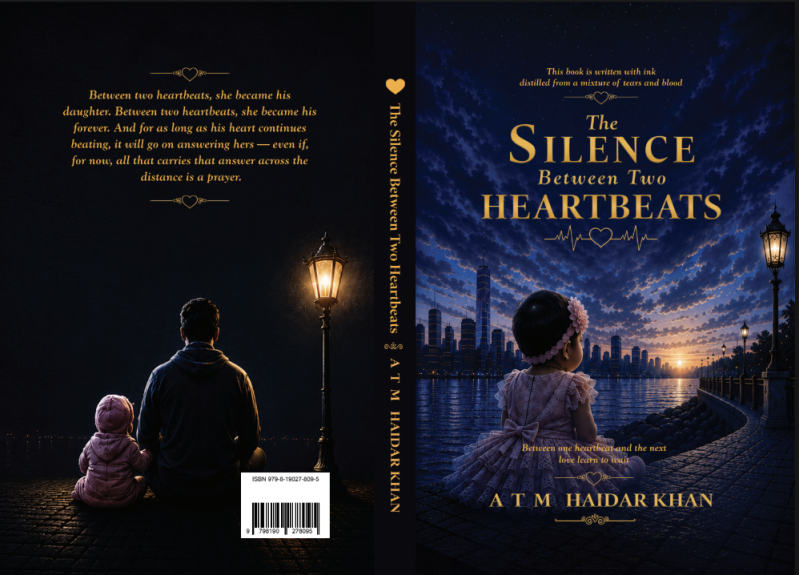
There is something inherently difficult about reviewing a book that carries so much of another person's life within its pages. As an editor and publisher, I have a responsibility to evaluate the quality of the writing, the effectiveness of the narrative, and its contribution to literature. However, as a father of six children, three boys and three girls, I also approach this work from a deeply personal perspective.
Fatherhood has taught me that there are few things in life more powerful than the love we have for our children. It has also taught me that, despite our best intentions, we cannot protect them from everything. There are circumstances beyond our control, questions we cannot answer, and moments when our greatest desire is simply to take away their pain.
While I cannot claim to understand the full extent of what A T M Haidar Khan and his family have endured, I can certainly appreciate the sentiment behind his words and the love that inspired this book.
The Silence Between Two Heartbeats is more than an account of a child's medical journey. It is a deeply personal expression of fatherhood, vulnerability, faith, sacrifice, and the enduring relationship between a parent and child.
It deserves to be considered both for what it accomplishes as a literary work and for what it represents as a human experience.
The Human Experience Behind the Story
One of the most moving moments occurs relatively early in the book, in the chapter titled Eight Years of Prayer, Eleven Hours of Motherhood.
After years of longing for a child, Fareesa's mother endures twenty-seven hours of labor, only to face the devastating reality that her newborn daughter must be transferred to another hospital.
Her words are remarkably simple:
“I couldn't even take Fareesa on my chest yet.” (p. 13)
Of all the elaborate descriptions of suffering and courage throughout the book, this particular sentence stands out. It requires no metaphor, no extensive explanation, and no dramatic embellishment. It captures something that many parents will understand immediately.
There is another moment shortly afterward when Fareesa's mother, still physically recovering from childbirth, struggles to walk uphill toward the hospital where her daughter is receiving treatment. Her husband walks beside her, unable to relieve either her physical pain or her emotional suffering.
There is considerable humanity in that scene. It reminds us that sometimes the only thing we can offer another person is our presence, even when we wish we could offer so much more.
Khan is particularly effective when he allows these smaller moments to carry the narrative.
In One Bottle, One Hour, something as ordinary as feeding a child becomes an exercise in patience and unconditional devotion. In Six Months Without a Night, the author explores the fear that follows a family home after hospitalization. The medical equipment may be gone, but the psychological consequences remain.
These chapters offer an important perspective on caregiving that is often overlooked. Leaving a hospital does not necessarily mean leaving behind the experience of being there.
As parents, we often celebrate the milestones our children achieve without fully appreciating how differently those milestones may be experienced by other families. What one parent considers an ordinary developmental achievement may represent weeks or months of uncertainty, determination, and hope for another.
Khan's account offers a meaningful reminder of that distinction.
The Complicated Nature of Fatherhood
Perhaps one of the most revealing chapters is The First Deception from the Man She Trusted Most.
The author recounts the guilt he experienced while concealing medication from his daughter by placing it at the top of her bottle's nipple. To an outside observer, this might appear to be a relatively unremarkable act of parental caregiving. To Khan, it represents an uncomfortable conflict between his responsibility to protect his daughter and his desire never to betray her trust.
The significance of this passage lies in its moral complexity. Here is a father who understands that he must sometimes do things his child cannot understand, even when those actions cause him considerable emotional discomfort.
As a father, I can appreciate that internal conflict.
Our children look to us for reassurance, security, and guidance. Yet fulfilling those responsibilities sometimes requires us to make decisions that are difficult for them to understand. We are not always afforded the opportunity to explain ourselves in a way that makes those experiences easier for them.
Parenthood rarely provides us with the luxury of knowing whether every decision we make is the right one. We act with the knowledge available to us, guided by love, responsibility, and the hope that our children will someday understand our intentions.
Khan's willingness to acknowledge his uncertainty gives the narrative a dimension that extends beyond the immediate medical circumstances.
There is a vulnerability in his writing that I believe deserves recognition. Fathers are often expected to remain composed, provide reassurance, and demonstrate strength during difficult circumstances. Khan allows himself to be frightened, exhausted, uncertain, and emotionally exposed.
There is nothing inherently weak about that vulnerability. In many ways, it is among the most authentic expressions of fatherhood presented in the book.
The Language of Faith and Hope
The author's Islamic faith is an important part of the narrative and deserves recognition as such.
Throughout the book, Khan returns to prayer, gratitude, and his relationship with Allah as sources of strength during circumstances that frequently exceed his ability to understand or control them.
What is particularly meaningful about these passages is that faith does not eliminate his fear. He continues to struggle with uncertainty, exhaustion, and helplessness despite his spiritual convictions.
His faith provides a foundation from which he attempts to endure those experiences.
Readers need not share the author's religious beliefs to appreciate the significance of these moments. Across cultures, religions, and personal philosophies, human beings search for meaning when confronted with circumstances that challenge their understanding of life.
Khan's spiritual identity gives the narrative a distinctive and personal voice while allowing its broader themes to remain accessible to readers from different backgrounds.
Two Worlds Within One Book
The most unconventional aspect of The Silence Between Two Heartbeats is its transition from personal memoir into an extended literary fairy tale.
Following the first sixteen chapters, the reader enters the Kingdom Between Two Heartbeats, a symbolic world inhabited by an Ancient Owl, a King, and a courageous Little Lioness.
Initially, this represents a considerable departure from the hospital corridors, medical treatments, and domestic experiences that define the first half of the book. Yet as the allegory develops, the relationship between these two worlds becomes increasingly apparent.
The father who spends his nights protecting his daughter becomes the King who must eventually recognize how much his daughter has influenced and protected him.
The Little Lioness, meanwhile, becomes a symbolic representation of courage, innocence, and the author's understanding of his daughter's love.
From an editorial standpoint, this is an ambitious creative decision. Rather than relying exclusively on the conventions of memoir, Khan introduces a second literary language through which he can explore experiences that are difficult to communicate directly.
One of the more intellectually interesting passages appears in The Forest of Mirrors, where the author introduces a forest that reflects not necessarily what is true, but what its visitors most desire to believe.
The Wise Queen's warning is particularly effective:
“Never fear the beasts that roar. Fear the mirrors that agree.” (p. 181)
This passage carries significance beyond the immediate narrative. It invites consideration of how readily human beings accept comforting explanations, particularly when those explanations protect us from uncomfortable realities.
It also raises questions about perception, confirmation, and the human tendency to seek reassurance rather than challenge our existing understanding.
Later, in The Day the King Followed the Little Lioness, the King discovers that behind a seemingly beautiful reflection there is nothing substantial. The scene marks an important development in his character. He begins to recognize the limitations of his own understanding and becomes willing to follow rather than always lead.
There is a meaningful connection here to the earlier chapters. The father who once believed that his primary responsibility was to teach and protect his daughter must eventually acknowledge that parenthood is also an experience through which adults themselves are taught.
Having raised children of my own, I appreciate that observation. We spend considerable time believing that our responsibility is to prepare our children for life, only to discover how frequently they challenge our perspectives and teach us lessons we might never have learned otherwise.
An Editorial Perspective
While the emotional significance of this book is undeniable, an independent literary assessment must also consider how effectively that emotion is communicated.
Khan writes with considerable intensity. His recurring references to heaven, darkness, light, warriors, sacrifice, and unseen battles create a recognizable literary identity. However, their frequency occasionally reduces their effectiveness.
There are passages where the author's desire to communicate the full magnitude of his feelings results in unnecessary repetition. At times, the narrative explains an emotion that the reader has already understood through the circumstances being described.
The book is often at its strongest when the writing is at its simplest.
The mother's words in the hospital, the father's sleepless nights, the pink bow resting upon Fareesa's head amid medical equipment, and the patience required to finish a bottle of milk communicate more than many of the extended philosophical passages.
These moments demonstrate that the author does not always need elaborate symbolism to communicate something profound. The experiences themselves possess considerable emotional weight.
The fairy-tale section presents a similar editorial challenge. Its symbolism is thoughtful, and its underlying concept is imaginative. However, several of its moral observations are revisited throughout subsequent chapters. A more concise treatment might have strengthened the allegory without sacrificing its meaning.
The transition between memoir and fantasy may also present a challenge for readers who approach the book expecting a conventional autobiographical narrative. While the prologue establishes the relationship between these two literary worlds, the substantial length of the allegorical section requires readers to adjust their expectations considerably.
There is also a distinction to be maintained between lived experience, reconstructed dialogue, and literary interpretation. The author acknowledges that portions of the work have been artistically reconstructed and that the fairy tale is metaphorical. That distinction is important when evaluating a work that combines personal testimony with imaginative storytelling.
I also found the burden of responsibility placed upon the Little Lioness worthy of consideration. In the author's symbolic world, a child repeatedly chooses to carry suffering in order to protect her father. Although this is intended as a tribute to Fareesa's influence on his life, it raises a worthwhile question about where the celebration of a child's courage ends and the idealization of childhood sacrifice begins.
Children can profoundly transform the lives of their parents without bearing responsibility for their parents' emotional well-being.
That tension deserves consideration, particularly because the book is so deeply concerned with the meaning of unconditional love.
Nevertheless, these are criticisms of literary execution and interpretation, not dismissals of the experiences that inspired the work. There is an important distinction between evaluating how a story is written and questioning the significance of the life from which it emerged.
The Mother Within the Father's Story
Although the central relationship throughout the book is between Fareesa and her father, I believe her mother deserves particular recognition.
In the acknowledgments, Khan openly recognizes that Fareesa's deepest bond has been with her mother and that her achievements are inseparable from her mother's patience, devotion, and sacrifice.
I appreciate that acknowledgment.
The mother's presence is woven throughout the narrative, even when she is not its principal subject. Her physical recovery, her separation from her newborn daughter, and her continued commitment to Fareesa represent a quieter but equally important dimension of the family's experience.
There is perhaps another book within this book, one that explores the same journey through the mother's perspective.
Her experience of waiting eight years for a child, enduring a difficult childbirth, and navigating the uncertainty that followed carries its own emotional and literary significance.
As much as this work celebrates the relationship between a father and his daughter, it also reminds us of the importance of recognizing the contributions of those whose sacrifices are not always at the center of the narrative.
Her contribution should not be overlooked.
Love Beyond Physical Presence
The section titled When They Wake Up changes the emotional significance of everything that precedes it.
The enchanted kingdom cannot permanently resolve the circumstances of the waking world. A wall remains between the father and daughter, and the narrative presents its removal as something that would cause suffering to Fareesa's mother.
Rather than offering the reader a conventional resolution, Khan presents a much more difficult understanding of love, one in which restraint and patience become expressions of devotion.
The circumstances behind that separation are not fully explained, nor is it necessary for a literary reviewer to speculate about them. What matters within the context of the book is the author's attempt to reconcile his longing for closeness with his desire to avoid causing further pain.
The epilogue continues this reflection. The father who once measured his days through hospital visits, medical milestones, and his daughter's breathing must confront the reality that he cannot control every circumstance affecting their lives.
This brings the reader back to a sentence introduced before the first chapter:
“Between one heartbeat and the next, love learns to wait.”
Its meaning becomes considerably deeper in the context of the book's conclusion.
What initially appears to be a reflection on the fragility of life gradually becomes a statement about patience, separation, acceptance, and the endurance of love.
It is an effective use of a recurring literary motif and, in my assessment, one of the author's strongest accomplishments.
Final Reflections
I do not believe every book needs to achieve literary perfection to make a meaningful contribution to the world.
Some books are valuable because of the questions they ask. Others because of the experiences they preserve. Still others because they offer readers a perspective that they might never otherwise encounter.
The Silence Between Two Heartbeats accomplishes elements of all three.
It is ambitious, occasionally repetitive, deeply sentimental, and unmistakably personal. Its combination of memoir, spirituality, and allegorical storytelling may not appeal equally to every reader, but its central themes are accessible to anyone who has experienced the vulnerability of loving another person.
As a father myself, I understand the desire to leave something meaningful behind for our children. We spend so much of our lives teaching them, protecting them, and preparing them for a world that we cannot always navigate on their behalf. Yet somewhere along that journey, we come to realize how much they have taught us about ourselves.
Perhaps that is what I appreciate most about Khan's work.
Beneath its symbolism, its philosophical reflections, and its emotionally charged narrative is a father who wants his daughter to know how much she means to him.
There is something profoundly human about that desire.
Years from now, should Fareesa return to these pages, she will encounter a written record of her father's fears, hopes, imperfections, prayers, and understanding of their relationship. Whether she ultimately understands those experiences in the same way he does will be part of her own journey.
For now, the book stands as his account of that love.
Literary imperfections aside, there is considerable value in preserving those sentiments through the written word. We cannot control every chapter of our children's lives, but we can leave them something that reminds them of how deeply they have been loved.
As an independent publisher, I believe there is an important place in literature for stories such as this. They preserve individual experiences, encourage difficult conversations, and remind us that behind every published work is a person attempting to communicate something they believe deserves to be heard.
A T M Haidar Khan has undertaken that responsibility with vulnerability, imagination, and considerable emotional commitment.
I would recommend this book particularly to parents, caregivers, families navigating childhood illness, readers of inspirational literature, and those interested in the relationship between personal experience and literary symbolism.
As an editor, I recognize the literary ambition of this work. As a father of six, I appreciate the sentiment that gave it life.
The Silence Between Two Heartbeats is a meaningful contribution to personal and inspirational literature, and a work worthy of thoughtful readership.
I wish A T M Haidar Khan, Fareesa, her mother, and their entire family continued strength, happiness, and peace in the chapters of their lives that have yet to be written.
About the Book
Title: The Silence Between Two Heartbeats
Author: A T M Haidar Khan
Publication Year: 2026
Edition: First Edition
Genre: Personal Memoir, Inspirational Literature, Spiritual and Literary Allegory
About the Reviewer
Dr. Nicholas J. Pirro holds a Doctorate in Business Administration and a Master of Business Administration. He serves as Editor-in-Chief of Pyrrhic Press Publishing, LLC, an independent publishing organization dedicated to expanding access to knowledge, supporting authors, and advancing meaningful literary and scholarly discourse. He is also a father of six children.
Editorial Independence and Disclosure
A complimentary digital review copy of The Silence Between Two Heartbeats was provided by the author. Pyrrhic Press Publishing maintained editorial independence in the preparation of this review. No payment was received in exchange for a favorable assessment.
This review evaluates the book as a literary work. The personal circumstances, medical events, and interpretations presented within the book have not been independently verified.
Pyrrhic Press Independent Book Reviews
www.pyrrhicpress.org
editor@pyrrhicpress.org
© 2026 Pyrrhic Press Publishing, LLC. All rights reserved.